

In a world where local government has a problem in managing its existing data ("Local authorities recorded 4,236 data breaches during a three-year period from April 2011, a study by privacy campaign group Big Brother Watch said - 11 August 2015."), and is under pressure from increased demand for services combined with a drop in income, the requirement to provide data under the Freedom of Information Act 2000 must feel like an unwelcome imposition at times. Agility DataBroker, a computer software framework from Arjuna, provides local authorities with a mechanism to solve current data-related problems including the publishing of data under the act.
Local government consists of a number of semi-autonomous disciplines each of which serves the same group of people, their constituents, from a different perspective. As a result of this segmentation, data can be duplicated, errors can proliferate, money can be wasted and decisions are often made without access to the information embedded in the data available. Joined-up thinking is difficult without joined-up data to base it on. It is not unusual for an audit to show that several hundred datasets are maintained across departments, and that most departments are not aware of the data available elsewhere in the authority. In one recent audit the existence of less than one third of data available was reported to senior management. Data is stored in databases, in spreadsheets, in digital documents, in paper form or a combination thereof. All of this is no secret to local authority executives and most have projects underway to improve the use of existing data to improve decision making.
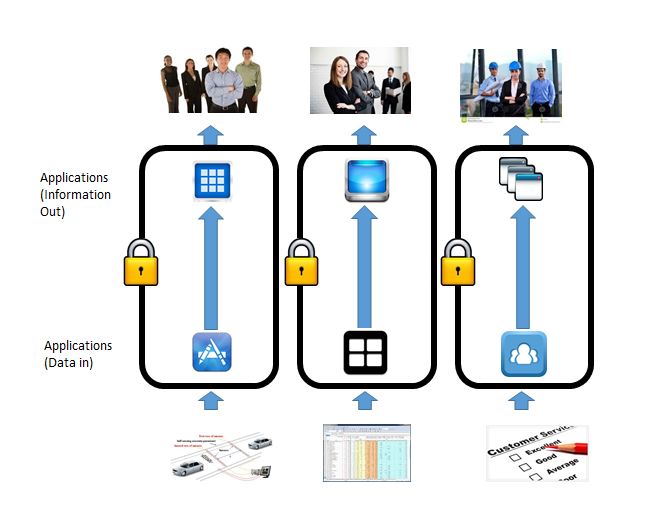
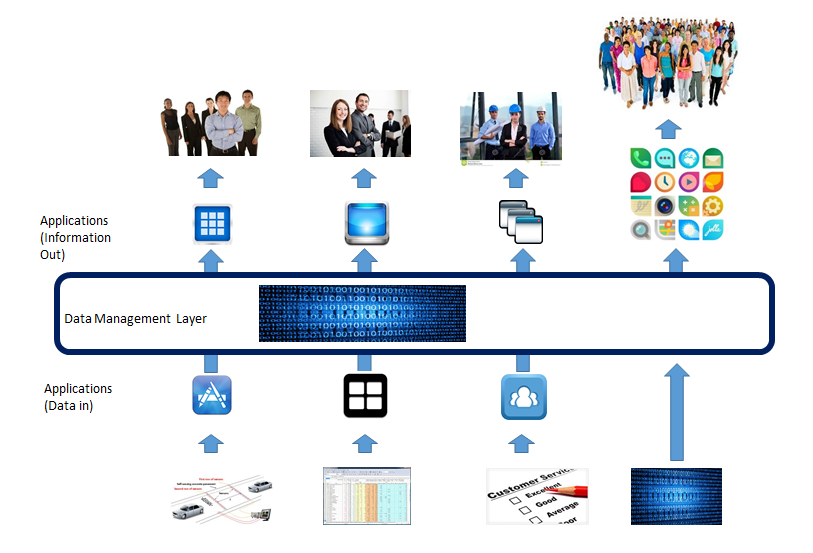
The requirement for good management of data is increased by the Freedom of Information Act. When much of the data is not catalogued then retrieval is time-consuming, and if it is not already published then distribution can be expensive. This is compounded when the data requested involves more than one department. In an environment where local authorities are continually expected to do more with less funding, any means of reducing the work and ancillary cost to provide data is of benefit; as is the resultant improved level of service to the community they serve. The implementation of Agility DataBroker allows an authority to consolidate access to data for easy, but controlled, audited use by those who are authorised. Agility DataBroker allows for data to be extracted from any combination of data sources, whether they sit in the Cloud or locally, under strictly enforced, but dynamically changeable service agreements which govern its use and deployment. Once access to data is consolidated, new services can be easily introduced.
One obvious first step towards cohesion is the use of a data portal where the existence of all local authority data can be "advertised" as being available to other departments and, potentially, to members of the public under the Freedom of Information Act. Data definitions can be input via screen-based forms into Agility DataBroker or Agility DataBroker can be used to automatically scrape the data to extract the metadata and publish it on a web based portal. Access to the underlying sensitive data can then be protected through the implementation of service agreements between the data owner and the requester under the control of flexible policies embedded within Agility DataBroker. The result is a single, manageable conduit to all publishable data that can then be extended to analysis in combination with third party data to provide the information that allows a modern authority to optimise the use of its resources.
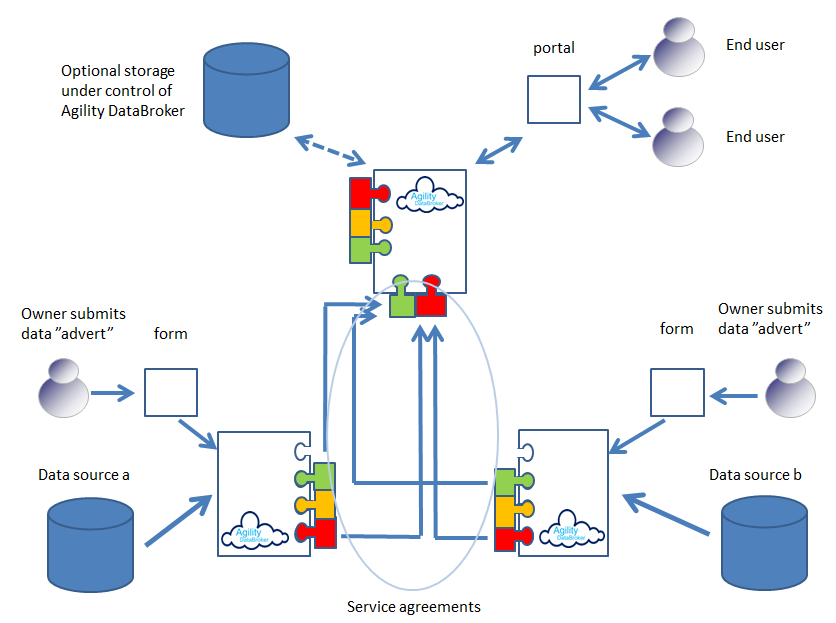
N.B. the illustration above shows three instances of Agility DataBroker whereas a single physical instance with multiple domains would work in a similar manner.
Agility DataBroker is a framework that allows an organization to unlock the value of data through its controlled consolidation, analysis and distribution. Agility DataBroker allows for data to be extracted from any combination of data sources, whether they sit in the Cloud or locally, under strictly enforced, but dynamically changeable service agreements which govern its use and deployment. Agility DataBroker is currently used within a number of local authority projects in the North East of England.


